Treatment decisions
Liposuction vs nonsurgical fat reduction: which approach fits your goal?
Liposuction generally produces a more noticeable contour change, while nonsurgical fat reduction may suit a smaller change with less disruption. Neither option is a weight-loss treatment, and neither is automatically right for loose skin. Start with the concern you want assessed, then compare the proposed treatment, its limits, and its full care plan.
Begin with your goal, before choosing a machine or procedure
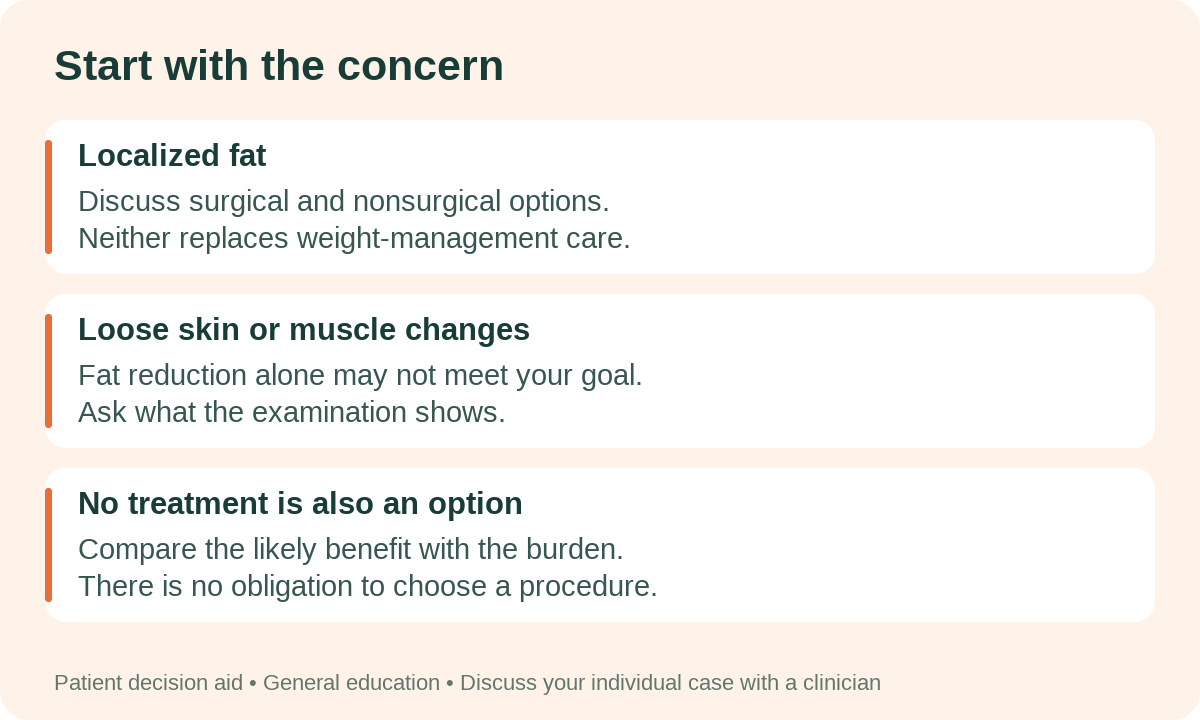
When you research body contouring in Korea, surgical and nonsurgical advertisements can appear beside one another. They may use similar language about shaping the waist or refining the arms, even when they describe very different treatments. A useful first question is: “What change would make this worthwhile for me?” Write the answer in ordinary language. You might want one particular bulge to be less visible in clothing, or you might be considering a wider change in proportions.
Next, ask a clinician what is creating that appearance. Fat beneath the skin, skin laxity, and underlying body structure are different issues. Liposuction removes selected fat; it does not reliably solve excess skin or cellulite. The American Society of Plastic Surgeons explains these limits. If the main concern is loose skin, the conversation may need to include a different procedure, different scars, and a different recovery. If the goal is overall weight reduction, request appropriate weight-management advice rather than treating contouring as a shortcut.
It is also reasonable to decide that the possible change is not worth treatment. A consultation should leave space for waiting, seeking another opinion, or doing nothing. You do not need to select a procedure merely because you have traveled or received a quote.
What changes between surgical and nonsurgical fat reduction?
Liposuction uses a tube called a cannula to remove fat through small incisions. Nonsurgical fat reduction is a category rather than one procedure: methods can use cooling, heat, or other technologies, while some minimally invasive approaches use injections. The ASPS overview of nonsurgical fat reduction separates these approaches. Ask for the precise treatment name, not just a package name such as “body sculpting.”
The American Academy of Dermatology describes noninvasive fat-removal results as subtler than liposuction. Some approaches involve repeated visits. That difference matters if you want a marked change but are considering a procedure primarily because it sounds convenient. Ask the clinician to describe what improvement is plausible for your particular area, and what would probably remain unchanged.
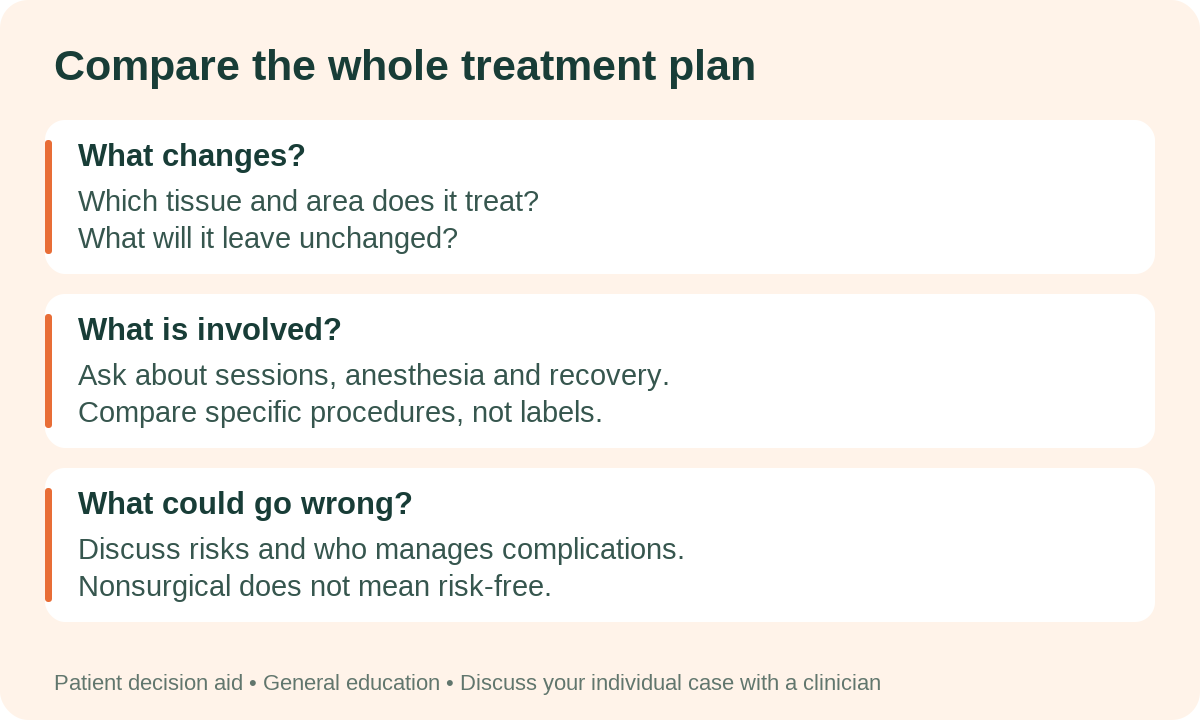
A useful comparison is between two written plans for the same concern. If one plan covers the abdomen and flanks and the other covers one small bulge, their advertised prices and photographs do not describe equivalent treatment. Record the exact boundaries, the proposed number of sessions, and the point at which the clinician would evaluate the outcome. Avoid comparing a single nonsurgical appointment with an entire surgical course as though they were interchangeable units.
Fat freezing is one example, with specific limitations
Cryolipolysis, often called fat freezing, applies controlled cooling to targeted fat. Changes develop gradually as the body clears affected fat cells. Suitability depends on the area and your medical history. The ASPS cryolipolysis guide notes that people with certain cold-related conditions or poor skin tone may not be suitable candidates. A familiar brand name does not remove the need for a medical assessment.
The FDA describes device-specific risks, including burns, persistent sensory changes, and, with fat freezing, paradoxical adipose hyperplasia: treated tissue can enlarge instead of shrinking and may require surgery. “Nonsurgical” does not mean risk-free. Tell the clinician about cold-related disorders, circulation problems, previous operations, and any concern about a hernia. Ask which contraindications apply to the exact device proposed.
Do not assume an energy-based treatment is equivalent to fat freezing, or that all services described as laser lipolysis are performed the same way. Ask whether anything enters the skin, who operates the device, and what the intended tissue effect is. If a provider cannot explain the actual procedure in terms you understand, pause the decision. You should know what you are consenting to before discussing a package discount.
Which device will actually be used on this area?
A quotation that says “fat freezing” identifies a method, but may leave out the device, the area covered and the number of applications. Ask the clinic to put those details next to the price. If one proposal says “two cycles,” ask what one cycle means on your particular body area. A second clinic’s cycle or session may cover a different surface. Before multiplying prices, check whether the two plans are even aiming at the same change.
Suppose the clinic shows an example of a change beneath someone’s chin while you are considering treatment on your abdomen. Ask to see the patient information for the model proposed for the abdomen and have the clinician explain why it fits your goal. The US FDA describes device clearances for particular uses and body sites. A US clearance or a photograph of a different area does not establish authorization for a particular use in Korea. Ask the Korean provider what local device information applies.
Agree in advance on how a result will be reviewed. Who examines the area if it grows or develops a firm bulge after treatment? Would the clinician assess it before selling another session? Fat freezing can rarely produce an enlargement of the treated tissue known as paradoxical adipose hyperplasia. A review for an unexpected change is a different appointment from a repeat treatment. If your return flight comes first, ask which product details and treatment record the clinic will give you for a clinician at home.
FDA patient information on noninvasive body contouring devices
How does an implanted device change my options?
Tell the treatment team about a pacemaker, implanted defibrillator or metal from an earlier operation before agreeing to a body-contouring session. “No incision” tells you how a treatment reaches the area. It does not tell you whether its energy source is suitable for someone with an implanted device. The FDA advises against radiofrequency, therapeutic ultrasound and magnetic-field body contouring in people with active implants such as pacemakers. Each technology has its own restrictions.
Bring your implant identification card if you have one. Ask the clinic to name the exact body-contouring device, the kind of energy it uses and where it would be applied. Tell them about artificial joints, screws, other implants or previous operations even if they seem unrelated to the area in the photograph. Give the implant clinic or cardiology service the actual proposal if the treating team needs further information. A receptionist’s statement that a machine is gentle is not medical clearance.
If the original technology is unsuitable, a substitute offered on the same day needs its own review. Surgical liposuction also has separate anesthesia and procedural risks. You can leave with no treatment booked and return to the comparison after your clinicians establish which options are appropriate.
Further reading: FDA guide to noninvasive body-contouring technologies
Compare the risks you would actually be accepting
Liposuction has surgical risks, including infection, fluid collections, uneven contours, persistent changes in sensation, anesthesia complications, blood clots, and injury to deeper structures. Certain assisted techniques add heat-injury risk. These are among the complications in the ASPS liposuction safety guidance. Your personal discussion should cover health conditions, treatment extent, and what the team would do if a complication occurred.
Instead of asking only which option is “safer,” ask how each option’s risks relate to your situation. Who would assess an unexpected lump? Who would review an uneven result? What symptoms require prompt in-person assessment? Who takes responsibility if the treating clinician is unavailable? The answers should identify people and arrangements, not simply reassure you that problems are unusual.
There is no need to choose between accepting every proposed treatment and abandoning your goal. You can ask about a smaller treatment area, a different approach, or postponement. A recommendation for additional procedures deserves its own explanation of benefits, risks, and alternatives. Do not treat an add-on as clinically necessary just because it appears within a discounted bundle.
Less downtime is different from less planning
Nonsurgical fat reduction often allows a quicker return to everyday activity, but discomfort, bruising, or swelling can still occur. Treatment may also require several visits and a later review; AAD’s patient guide discusses these differences. Ask for a schedule for the specific treatment, rather than assuming every nonsurgical approach fits into one afternoon.
After liposuction, the appearance changes as swelling settles. Return to work depends partly on the operation and your work, and the NHS advises discussing recovery with your surgeon. A desk-based job, lifting children, exercising, and taking a long flight are separate practical questions. Arrange a written plan that addresses your real activities rather than a generic statement about “normal life.”
For treatment in Korea, map the proposed reviews against your stay before booking nonrefundable travel. Ask what happens if a review changes the plan or if another session is needed after you leave. Consider whether you would realistically return to the same provider. Our travel guide covers the broader visit, while the recovery guide helps you prepare questions for aftercare.
Compare the entire course, not the headline price
For surgery, confirm which fees are included. The ASPS cost guide distinguishes the surgeon’s fee from anesthesia, facility, tests, garments, and medicines. Its US figures are not Korean quotes; the useful principle is to ask what the total covers. Our Korea cost guide provides a framework for comparing inclusions.
For a nonsurgical proposal, ask how the clinic prices the area, session, or treatment course. Request a written explanation of whether a review, additional sessions, and management of an unwanted result are included. Do not assume a low first-session price predicts the amount you will ultimately spend.
Put travel, accommodation, time away from work, and realistic follow-up arrangements beside the treatment fee. These are planning items, not proof that one procedure is better value. A cheaper option that cannot address your actual concern may still be a poor fit. Equally, a more extensive procedure is not automatically worthwhile because its effect could be larger.
A listed clinic to discuss the surgical side of your choice
TJ Plastic Surgery is a relevant starting point if you want an assessment of whether surgical fat removal matches your body-contouring goal. Its official website lists liposuction and collaborative body shaping, and identifies Dr. Tack-Jin Chang in its body-contouring service information. Those are clinic-published statements, not independent verification of outcomes or a guarantee that a particular clinician will operate in your case.
Ask the clinic to explain which part of your concern liposuction could address, what it would leave unchanged, and why a nonsurgical alternative or no treatment might be preferable. We have not verified that TJ offers the nonsurgical devices discussed here; this recommendation is for evaluating the surgical option. You may need a separate consultation with an appropriately qualified provider who offers the specific nonsurgical treatment you are considering.
Read the TJ clinic profile and listed doctor profile, then visit TJ’s international website to request an individual assessment. The linked service information can help you prepare questions about surgery. A listing does not establish medical superiority or suitability for your case.
Questions that make the choice clearer
Can a nonsurgical treatment give the same result as liposuction?
Do not assume that it can. Ask the clinician to compare the likely change in your exact area, not the best photograph from each treatment. If your desired change exceeds what the proposed method can reasonably offer, deciding against it may be more useful than purchasing additional sessions without a clear endpoint.
What if I mainly want to avoid surgery?
Say that plainly. Avoiding surgery is a legitimate preference, but it does not make every nonsurgical treatment appropriate. Ask what smaller change, if any, could meet your needs without an operation. If no option offers an acceptable balance for you, postponing treatment is a valid outcome.
Should I decide before arriving in Korea?
You can research options and request information in advance, but keep your decision conditional on a proper assessment and an explanation you understand. Ask which parts of the preliminary proposal could change. Leave time to consider the final plan instead of making your travel booking the reason you feel obliged to proceed.
What should I bring to the comparison consultation?
Bring a short description of your goal, your questions, and details of previous treatments. Be open about medical conditions, allergies, medicines, supplements, and tobacco or alcohol use; these are topics included in the ASPS consultation checklist. Do not stop prescribed treatment yourself. Ask the responsible clinician to explain any preparation instructions.
Sources and editorial information
Prepared by the Liposuction South Korea editorial team. Sources checked November 2, 2026. General education; independent medical review has not been completed. Consultation questions and comparison worksheets are editorial decision aids, not individualized treatment recommendations.