How long do liposuction results last?
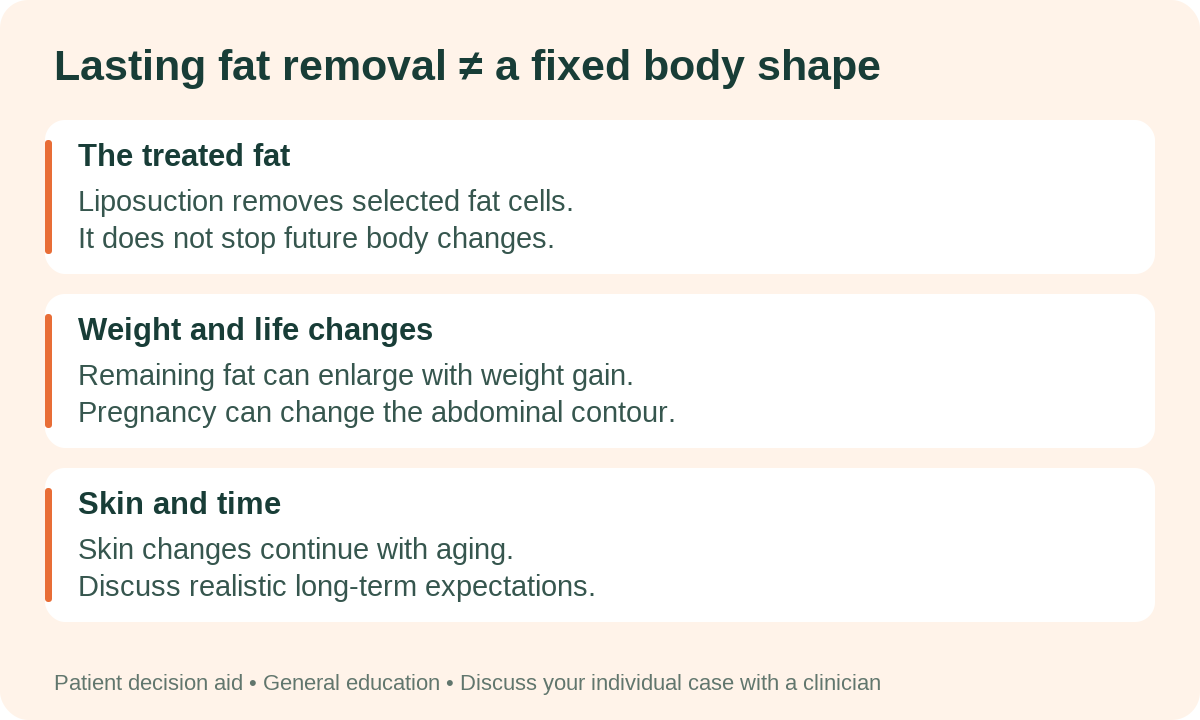
Liposuction can produce a lasting change in body contour, but it does not hold your body at one shape forever. The removed fat cells are gone; the fat that remains, your skin, and your body’s proportions can still change. Weight changes, aging, and pregnancy all belong in the conversation before you book treatment in Korea. ISAPS explains this distinction.
What does “permanent” actually mean?
It helps to separate the procedure from the appearance it produces. Surgery removes some fat from a particular area. It does not remove every fat cell in that area, and it does not prevent weight gain elsewhere. A treated waist can therefore change again even though the original operation removed fat successfully. The Aesthetic Society’s results guidance describes this difference between permanent removal and a result influenced by later life changes.
For your consultation, replace “Will it last forever?” with two more useful questions: “Which part of my concern can this operation change?” and “Which changes could still happen afterward?” Ask the surgeon to discuss your actual treatment area. A general promise about permanent results does not explain how your skin might settle or what a major change in your weight could mean for your chosen contour.
There is no single expiry date that applies to everyone. The American Academy of Dermatology describes results lasting for years while noting that weight gain can make the improvement less noticeable. Treat a promise of a particular number of years as a claim to question, especially if it is presented without discussing your health, skin, or future plans.
Early swelling is a different question from long-term durability
Your first postoperative photographs are not a reliable starting point for judging how well the contour will last. Swelling and fluid retention obscure the result while healing progresses. ASPS explains that swelling may take several months to settle and that outcomes cannot be guaranteed.
Ask when your surgeon expects to make a meaningful assessment and which changes should prompt an earlier examination. Keep the planned follow-up appointments even if you have returned home. A photograph sent from overseas can support a conversation, but ask when the clinician would need to examine you in person. Do not turn an internet timeline into a deadline for your own body.
Our recovery guide covers the practical early phase. This article focuses on the separate decision of whether your expectations and future circumstances fit a lasting contouring procedure. If your concern is an unexpected new symptom, contact a clinical professional rather than using a discussion about long-term results to explain it away.
What happens if your weight changes?
Remaining fat cells can enlarge after weight gain, including in an area that has been treated. Future fat distribution is not something a clinic can precisely promise. Substantial weight loss can also affect the overall appearance. The Aesthetic Society identifies both weight gain and weight loss among the factors that can change the outcome.
This does not mean you must promise never to change weight again. It means the surgical plan should account for the stage of life you are in. If you are already pursuing a substantial weight change, tell the surgeon before comparing treatment packages. Ask whether a later assessment would provide a clearer picture of the concern you want treated. Do not stop or alter prescribed weight-management treatment simply to fit a cosmetic booking.
A useful preparation exercise is to write down your recent weight pattern in broad terms: relatively steady, gradually changing, or fluctuating. Add any intended change and the care you are receiving. You do not need to send a long daily log to a coordinator unless the clinic requests it. The purpose is to give the clinician context, not to pass a test of willpower or qualify for a promise.
Liposuction is a contouring operation rather than a substitute for weight-loss care. ISAPS also distinguishes fat beneath the skin from visceral fat deeper in the abdomen, which liposuction does not remove. Ask which tissue is creating the fullness that concerns you instead of assuming every change in abdominal size has the same cause.
If my waist is smaller, will my blood sugar or cholesterol improve?
A smaller waist after liposuction tells you that the outline has changed. It cannot tell you whether blood sugar, cholesterol or blood pressure has improved. Liposuction removes selected fat beneath the skin. It is a contouring operation, and the amount removed is not a measure of how well your body responds to insulin.
A small clinical study measured women before and after large-volume abdominal liposuction. Although the operation reduced abdominal subcutaneous fat, the investigators did not find significant improvement in insulin sensitivity or the measured cardiovascular risk factors. That study does not predict an individual patient’s lab results. It does illustrate why a clinic photograph, dress size or number of litres removed cannot substitute for the checks a clinician uses to guide diabetes or heart-risk care.
Before deciding, write your two goals separately. “I would like this waistband to fit more comfortably” is a contour goal to discuss with a surgeon. “I hope to reduce my diabetes medication” is a treatment question for the clinician managing your diabetes. If the second goal is what matters most to you, consider whether the operation answers your reason for seeking care. Keep your usual follow-up appointments, and ask the prescribing team about any medication changes around surgery. Changing a dose because a garment fits more loosely can put your health at risk.
Further reading: Study of metabolic outcomes after abdominal liposuction · American Society of Plastic Surgeons overview of liposuction
Skin quality still matters as you age
Removing fat and removing excess skin are different treatment goals. Liposuction does not reliably correct substantial skin looseness, and the body continues to age after surgery. A result can remain meaningfully improved while becoming less firm over time. ASPS’s results guidance makes both points explicit.
Before agreeing to treatment, ask the surgeon to describe the expected change in volume separately from the expected behavior of your skin. If loose skin is your main concern, request an explanation of the alternatives and their tradeoffs. A tummy tuck, for example, removes excess skin and fat and may address weakened abdominal muscles; it is a different operation with a different decision to make. See ASPS’s tummy-tuck information.
You are allowed to decide that the scars, recovery, or extent of another operation do not fit your priorities. You can also decide to leave a contour concern untreated. A good consultation should make those choices understandable. If a package combines fat removal with another procedure, ask for each procedure’s purpose, risks, expected benefit, and price rather than accepting one broad label such as “complete shaping.”
Bring future pregnancy plans into the decision
Pregnancy can change a liposuction result. BAAPS patient guidance specifically identifies pregnancy and weight gain as changes that affect the outcome. That is a reason to discuss your plans, not a reason for a website to make reproductive or surgical timing decisions for you.
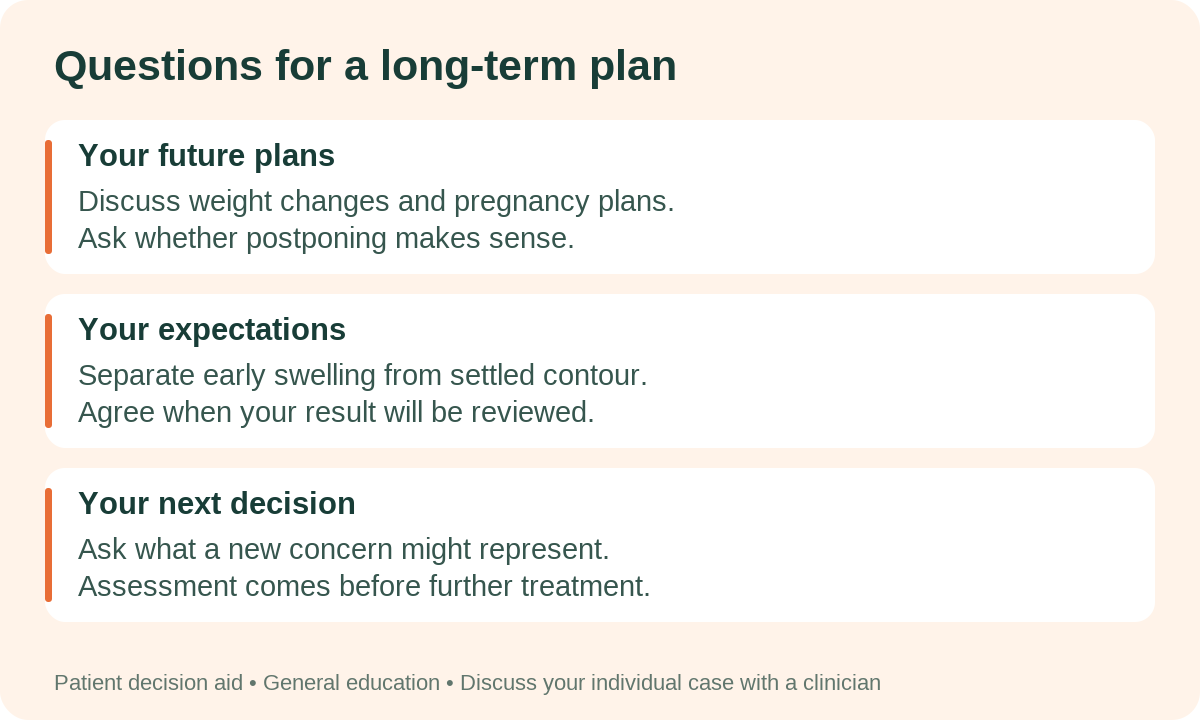
If pregnancy is possible or planned, raise it with the surgeon before paying a deposit. If you have recently given birth, discuss your recovery and any relevant ongoing care with the clinicians who know your situation. Ask whether waiting would change the treatment recommendation and what information the surgeon needs to assess you. A fixed waiting period from someone else’s social-media account is not a personalized assessment.
Be particularly careful with language about “getting your body back.” Choose a goal that is your own and describe the specific concern you would like assessed. You do not need to make a cosmetic decision to meet a deadline, a partner’s preference, or a photograph of someone else. If your plans are uncertain, an information-only consultation can still be useful without committing to surgery.
Plan for follow-up beyond your trip to Korea
Before traveling, ask how the clinic reviews the developing result after you leave. Separate routine photo reviews from assessment of a problem that needs examination. Find out who receives messages, how to obtain your records, and whether you would need to return for an in-person appointment. Put the answers alongside your travel plan, rather than treating aftercare as a detail to settle at checkout.
For a useful record, ask the clinic how it wants follow-up photographs taken and stored. Keep dates and the procedure summary with the images. Consistent photographs make discussions easier, but they cannot establish a diagnosis on their own. Avoid measuring your outcome against selected promotional images; ask whether a displayed case had similar starting concerns and how long after treatment it was photographed.
Clarify the financial terms of later assessment. Does the quoted price include planned reviews? What would you pay for an additional procedure, anesthesia, or facility use? Who covers new flights and accommodation? A phrase such as “revision support” needs a written definition. Our cost guide can help you compare quote inclusions without assuming that a future correction is free.
What if the contour changes or you are disappointed?
Ask for an assessment of the cause before asking for more fat removal. A concern can involve skin, residual fullness, healing, or an uneven contour, and the appropriate response may differ. ASPS lists loose skin, asymmetry, altered sensation, fluid accumulation, infection, and possible revision among liposuction risks; surgery also carries anesthesia and clot-related risks.
Write down what bothers you, when you noticed it, and whether it is changing. Bring the original operation details to a second opinion if you seek one. Ask what improvement is realistic, what would remain, and what happens if you choose observation instead. The revision guide explains the separate assessment needed when considering another operation.
For day-to-day care, follow your own team’s instructions. Do not intensify exercise, massage, compression, or dieting to force the contour to settle faster. The NHS liposuction guide emphasizes discussing activity and recovery with the surgeon. A change that concerns you deserves a clinical conversation, even when it occurs outside the schedule you were given.
Which two points in time are you comparing?
“My shape has changed again” can describe several different experiences. A preoperative photograph compared with one taken shortly after surgery asks a different question from two photographs taken years apart. Before a follow-up visit, put dates on any images you want to discuss. Label which were taken while you were still recovering and whether the position, clothing or camera angle differed. Keep the original files alongside any annotated copy. You do not need to recreate an uncomfortable pose, measure yourself repeatedly or produce a photograph to justify asking for an examination.
Use an ordinary activity as a second reference point. For instance, a waistband that became comfortable after recovery may feel tight again, even if two pictures look similar. Write down when you noticed the change, whether it was gradual and what else had changed in the meantime. If clothing, mobility or discomfort is your concern, say that directly. A surgeon can assess those questions more meaningfully than a request to match the outline of an edited image.
Ask the clinician to distinguish what is visible, what requires examination and what cannot be attributed to the original operation. Normal changes in weight and aging can affect appearance. Newly developing pain, swelling or a localized change deserves clinical assessment on its own terms. If further surgery is suggested, first ask which finding it would address and what the alternatives are. A side-by-side photo can start that conversation, but it cannot establish a cause or show that another procedure is appropriate.
American Society of Plastic Surgeons on liposuction results
A listed clinic to discuss long-term expectations
Soonplus Plastic Surgery is a relevant starting point for discussing the distinction between fat and skin concerns. Its current official website lists body liposuction and body-lift services. Those listings make it appropriate to ask which approach, if any, matches your concern; they do not establish that you need either procedure or predict your result.
Review the Soonplus platform profile, then visit its international website to request a consultation about weight stability, skin quality, and future plans. Confirm the operating clinician, current service availability, language support, and follow-up arrangements directly. The service listing was checked on the clinic’s Korean-language website; it is provider-reported information, not an independent audit of outcomes.
Use the linked service information as a research starting point. A listing does not establish clinical superiority or provide a personal medical endorsement.
Questions patients often ask
Will the fat simply grow back in the same place?
The removed cells are no longer present, but remaining fat can enlarge. Think of lasting removal and later body change as two compatible facts. Ask the surgeon to explain the likely implications for your chosen area without promising exactly where future weight will appear.
Does maintaining my weight guarantee the same appearance?
No. Weight is one factor, while skin, aging, pregnancy, and individual healing also matter. A stable weight does not guarantee perfect symmetry or prevent all future changes. Discuss a realistic range of improvement rather than a permanent replica of a photograph.
Should I book before or after a planned major life change?
Bring that change into the consultation before you book. Ask how waiting could affect assessment, recovery logistics, and the value of the procedure to you. It is reasonable to postpone an elective decision while you clarify your priorities and clinical circumstances.
Sources and editorial information
Prepared by the Liposuction South Korea editorial team. Sources and provider information checked November 2, 2026. This article provides general education and has not undergone independent clinician review.